Global demand for rare football artifacts has produced some of the most dramatic football memorabilia auctions in history.
Record sums have been paid for match-worn shirts, early rule books, and historic trophies, reflecting nostalgia, cultural importance, and fierce competition among elite collectors.
Cross-sport momentum matters as well, since a broader boom in record-breaking sports memorabilia has reinforced confidence in blue-chip items across categories.
What Drives Sky-High Prices
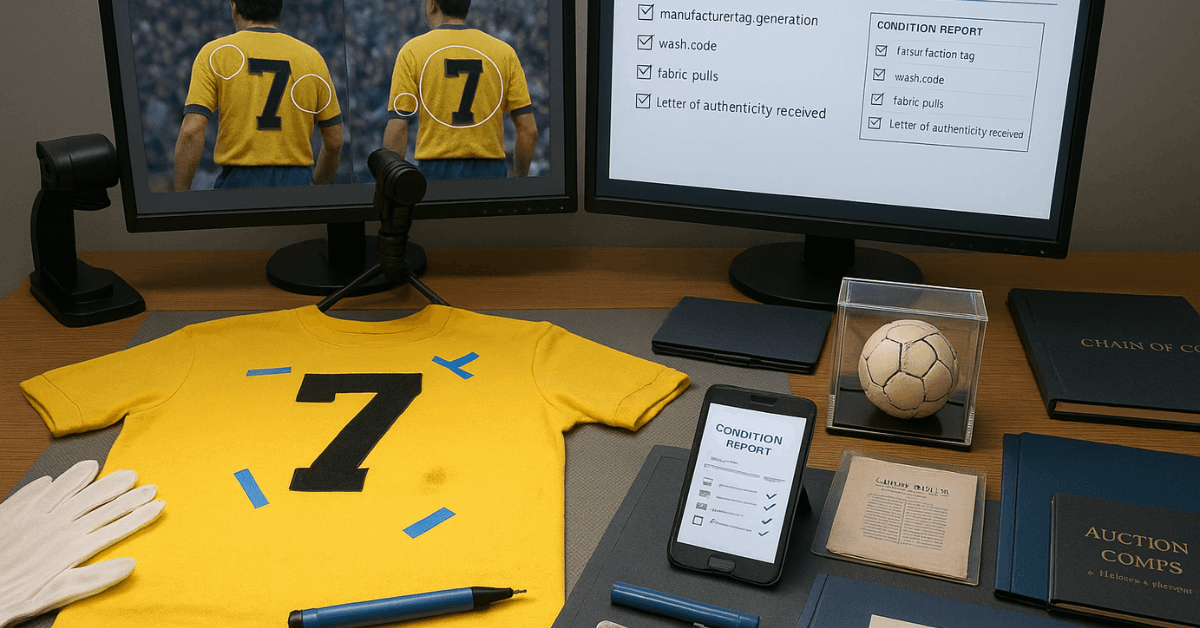
Scarcity tied to an indisputable historical moment sets the baseline for extraordinary outcomes. Provenance, clear, documented ownership and photo-matching, reduces uncertainty and amplifies willingness to pay at the top end.
Collectors also watch headline sales in adjacent sports, where landmark jersey prices validate the financial potential of elite artifacts.
Strong collector bidding behavior appears during media-charged sales and when authenticated items surface after long absences, creating urgency among seasoned buyers.
The Auction Houses Shaping The Market
Specialist firms curate supply, verify stories, and stage events that attract international bidders.
Graham Budd has reported a recent run of standout results, signaling robust demand for world football collectibles and a market tilt toward photo-matched shirts and early printed ephemera. Hansons has built a Wembley-based calendar, its Hansons Wembley auction format, designed to connect fans with storied lots across eras.
Understanding auction house provenance procedures, in turn, helps serious collectors evaluate documentation before committing capital.
The Landmark Results That Define Value
Expect short, focused snapshots of the most influential results across eras. Each example ties cultural memory to verifiable evidence, which is precisely where value concentrates.
Prices below reflect reported hammer plus premiums where sources specify; figures illustrate market scale rather than investment guidance.
Diego Maradona’s “Hand Of God” Shirt — £7,142,500 (Sotheby’s, 2022)
The quarter-final shirt from Mexico ’86, tied to both the infamous handball and the “Goal of the Century,” reset football’s ceiling and cemented match-worn shirts as the apex category.
Lionel Messi’s 2022 World Cup Shirts — $7.8 million (Sotheby’s, 2023)
Six first-half shirts from Qatar, including the final, realized the year’s top sports-memorabilia total and underscored the primacy of authenticated match-worn football shirts. Portions supported children’s health initiatives.
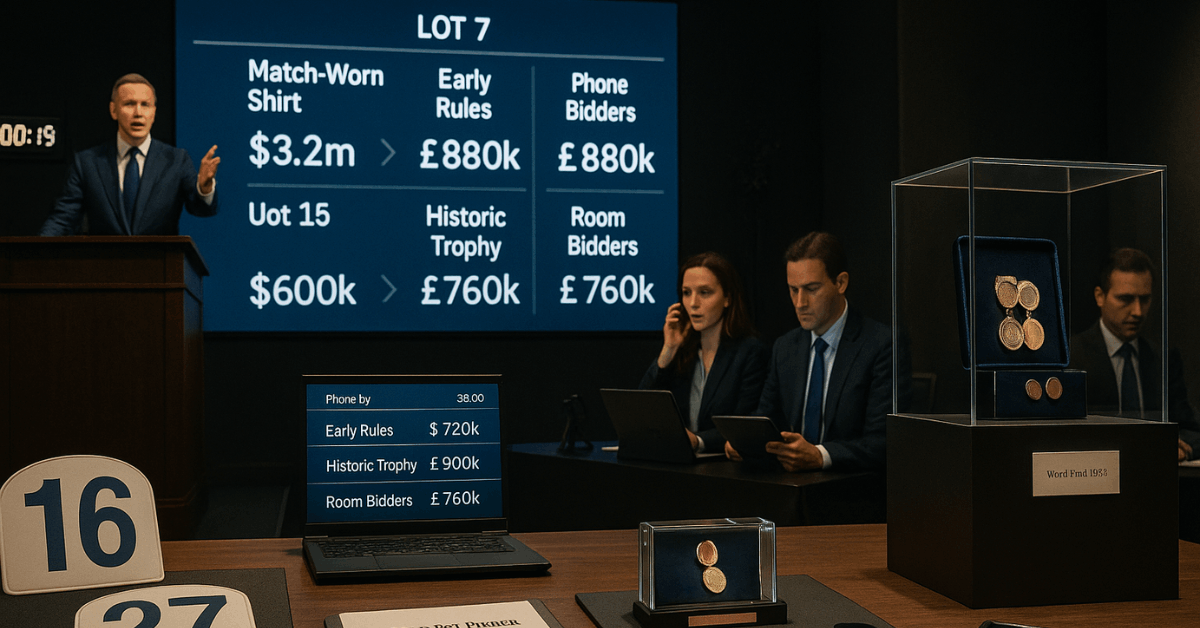
The Sheffield Rules — £881,250 (Sotheby’s, 2011)
Football’s earliest printed laws, linked to Sheffield FC, embodied the game’s formative codification and commanded a literary-manuscript level price.
Lionel Messi’s Barcelona “Napkin” Agreement — £762,400 (Bonhams, 2024)
The signed napkin documenting an agreement-in-principle for Barcelona to sign a 13-year-old Messi turned a humble artifact into a singular piece of modern football history.
FA Cup Trophy (1896–1910) — £760,000 (2020)
The oldest surviving FA Cup, used for presentations over 14 seasons, realized a landmark sum and later changed hands from owner David Gold, highlighting trophy scarcity at scale.
Jules Rimet Replica — £254,500 (Sotheby’s, 1997)
FIFA purchased an illicit FA-made replica amid rumors it could be the long-lost original; later X-ray analysis confirmed replica status, yet the price remains a touchstone for historic World Cup artifacts.
Nobby Stiles’ 1966 Winner’s Medal — £188,200 (2010)
Manchester United acquired Stiles’ medal for its museum, illustrating how clubs sometimes return legacy pieces to public view while establishing transparent stewardship.
Alan Ball’s 1966 Winner’s Medal — £200,000 hammer; £252,800 with fees (Tennants, 2022)
Ball’s medal sold strongly alongside his No.7 final shirt and cap, demonstrating persistent appetite for 1966 material when documentation is airtight.
Pelé’s 1970 World Cup Final Shirt — £157,750 (Christie’s, 2002)
Once the shirt record, Pelé’s final jersey established early benchmarks for Brazil’s golden era memorabilia and signaled long-run demand for transcendent figures.
George Best’s 1968 European Cup Medal — £156,000 (2010)
Best’s medal captured the enduring pull of Manchester United’s first European title and the iconography surrounding its mercurial star.
Emerging Themes Across Eras
Market leaders overwhelmingly center on match-defining moments and easily verified use. Shirts linked to famous goals, finals, or turning points consistently outperform generic signatures.
Early documents such as the Sheffield Rules show that foundational texts carry cross-collecting appeal beyond sport.
Cross-sport signals also matter: the $10.1 million sale of Michael Jordan’s 1998 Finals jersey validated elite jersey valuations and reinforced confidence around football’s most important shirts.
Practical Buying Guidance For Serious Fans
Serious collecting rewards method, documentation, and disciplined bidding. Provenance and narrative strength drive most pricing gaps, especially at higher grades.
Costs rarely stop at the hammer, so careful modeling protects capital and confidence. Relationships with reputable houses unlock previews, better information, and faster resolution when issues arise.
Treat Provenance As Non-Negotiable
Clear provenance protects capital and removes doubt during resale. Strong files also speed insurance, export, and grading decisions.
Demand photo-matching to the exact event, plus chain-of-custody through prior owners.
Favor independent authentication over seller-issued certificates, and archive invoices, programs, or period media mentions. Request high-resolution scans of serials, entry marks, and seat data, then store files redundantly for audit readiness.
Target Decisive Matches, Trophies, And Records
Narrative clarity compounds value because buyers immediately understand significance.
Ambiguous friendlies or exhibition dates usually trail decisive fixtures.
Prioritize finals, record milestones, rivalry flashpoints, debuts, and last appearances where attribution reads cleanly.
Confirm opponent, venue, and date on the ticket or paperwork, and cross-check against box scores or official match reports before committing funds.
Model All-In Costs Before Bidding
Sticker prices mislead without premiums, taxes, logistics, and currency friction. Transparent math prevents overbids and protects liquidity.
Build a simple equation: hammer price + buyer’s premium + VAT or sales tax + duties + shipping + insurance + payment and FX fees.
Set a hard maximum on an all-in basis, then walk away once surpassed. Include grading, encapsulation, and long-term storage costs when targeting condition-sensitive upgrades.
Track Auction Cycles And Result Databases
Supply clusters around anniversaries, documentaries, and seasonal consignment windows. Monitoring cycles sharpens timing and negotiation.
Review Graham Budd Auctions results and calendar trends, then watch the next Hansons Wembley auction for comparable football material.
Log estimates, realized prices, and condition notes in a personal sheet, flagging unsold lots for potential post-sale offers. Expect stronger bidding near milestone anniversaries and major tournament build-ups.
Build Relationships At Specialist Houses
Access improves when teams recognize serious, prepared buyers. Early looks and frank condition guidance reduce mistakes.
Attend previews, request detailed condition reports, and ask direct questions about provenance standards and return policies.
Register interest lists for specific athletes, clubs, or tournaments to receive vetted consignment alerts. Discuss payment timelines, consolidated shipping, and fees ahead of time, then follow through professionally to earn future first calls.
Conclusion
Serious collectors concentrate capital where story, authenticity, and visibility intersect. Focus collections on culturally resonant shirts, historically significant documents, and officially awarded medals, then let rigorous verification do the heavy lifting.
Staying close to specialist calendars and monitoring headline results in adjacent sports keeps strategy aligned with where this market is actually moving.