The 1970 World Cup Album stands as the first fully licensed Panini World Cup collection and the catalyst for a global sticker movement that still grips fans every four years.
As a snapshot of Mexico ’70, Brazil’s triumph, Pelé’s mastery, and attacking football under bright new color broadcasts, it became both a cultural artifact and a benchmark for sports memorabilia.
Collectors prize it for origin status, rich player selection, and documented variants, while historians view it as the point where modern fan engagement, mass media, and football merchandising converged.

Why The 1970 World Cup Album Matters
Pioneering status drives historical weight. Panini’s Mexico ’70 release launched the company’s officially licensed World Cup line, establishing the now-familiar format of team pages, portraits, and tournament iconography.
That start made later albums legible to every new generation of collectors and turned the inaugural edition into a reference piece for set builders and museums.
Mexico ’70 is often ranked among the greatest tournaments, remembered for Brazil’s artistry and stars such as Pelé, Franz Beckenbauer, and Bobby Moore. The album captured those squads just as global television entered the color era, transforming how fans experienced kits, crests, and faces.
1970 Context And Innovations
Color broadcasting reshaped how fans experienced international football and its memorabilia.
Mexico ’70 became the first World Cup widely available in color, which sharpened on-screen detail and raised interest in high-fidelity printed imagery.
Collector demand followed improved visibility of kits, badges, and faces, strengthening appetite for album photography. These shifts set a baseline for how modern sets present players and teams.
Color Television And Visual Memory
Color TV expanded beyond pilot markets and turned World Cup viewing into a richer visual record. Clearer broadcasts highlighted kit colors, sponsor marks, and tactical scenes that translated cleanly to album stickers.
The improved reference quality reduced guesswork for printers and elevated buyer expectations for sharpness. Albums that mirrored broadcast clarity gained an early reputation for premium presentation.
Global Reach Beyond Europe
Mexico ’70 accelerated international adoption beyond Italy and the UK due to wider broadcast carriage.
Availability in Latin America and parts of Asia broadened the buyer base for licensed football collectibles.
Cross-border distribution supported multi-language inserts and regional pricing, normalizing albums as global souvenirs. Broader reach reinforced print runs while still preserving early-issue scarcity in specific markets.
Panini’s Early Growth And FIFA License
Panini, founded in Modena in 1961 by the Panini brothers, was emerging from newsstand roots.
Early domestic sports issues built operational muscle in printing, collation, and kiosk logistics at scale.
Securing FIFA licensing for 1970 aligned authentic team marks and tournament branding under one product line. That agreement crystallized Panini’s identity as a global leader in licensed collectibles.
Design And Production Advances
Adhesive and paper choices improved handling and album longevity compared with earlier decade issues.
Tighter cutting tolerances and better color separation reduced misalignments that previously plagued photo-heavy sets.
Packaging formats supported impulse buys at kiosks while enabling economical replenishment for repeat collectors. These production gains elevated perceived quality and helped sustain demand beyond the tournament window.
What’s Inside The Original Mexico ’70 Set
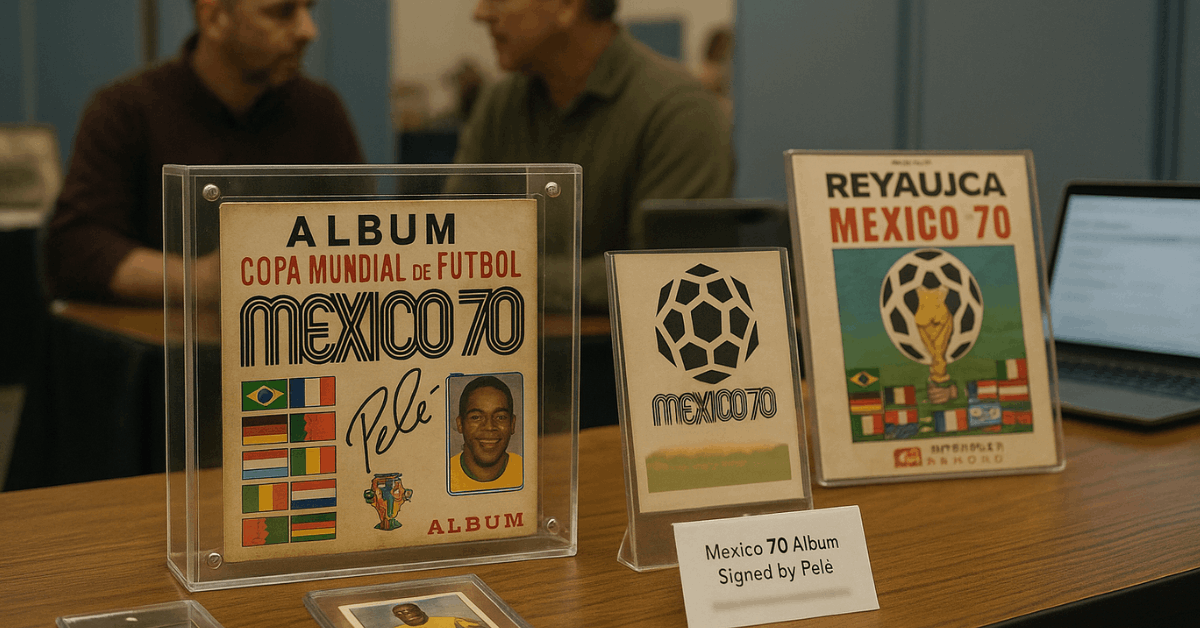
The Panini Mexico 70 album combined glued cards with a smaller subset of peel-off stickers, an approach later replaced by all-sticker formats.
Contemporary documentation commonly cites a 288-item run across roughly 48–50 pages; Catawiki’s record Pelé sale, however, described 271 stickers adhered in the winning copy, reflecting how some counts separate cards from stickers.
The structure starts with tournament pages, followed by national teams with logos, portraits, and team photos.
Collector Market Signals And Values
Interest follows clear signals that recur with vintage sports issues:
Origin Premium
Origin premium anchors pricing because this edition represents the first Panini World Cup release.
Firsts establish historical significance, which collectors translate into durable demand and stronger auction resilience. Later reprints rarely achieve similar status unless paired with exceptional scarcity or provenance.
Condition, Completeness, And Provenance
Condition, completeness, and provenance dominate valuations since buyers pay for preservation and certainty.
Full albums with intact pages, clean surfaces, and matching-era adhesives consistently outperform loose singles. Documented ownership trails and photo-matched signatures further compress buyer risk and lift clearing prices.
Pelé Signed Album Benchmark
A Pelé signed album set a Catawiki auction record in 2017 at about €12,038 (£10,450). That benchmark illustrates how star power plus complete presentation compounds value beyond typical comps.
Comparable results require equivalent authentication, similar condition, and clear signature placement.
Sticker Economics And Completion Cost
Broader sticker economics show cost gravity that shapes collecting behavior.
A Cardiff analysis estimated roughly £774 to complete Russia 2018 solely via packs, reinforcing why swaps and targeted singles remain rational. Completion math influences demand for partial sets, trading events, and bulk-lot pricing.
Media And Anniversary Cycles
Media coverage and anniversary cycles periodically spike demand, particularly around FIFA World Cup years.
Documentary releases, milestone tributes, and museum exhibits can redirect attention toward early Panini eras. Savvy collectors track these calendars to time listings and avoid peak-buying frenzies.
How The Album Sparked A Global Sticker Culture
Sticker collecting became a pre-tournament ritual across more than one hundred countries, reinforced by playground exchanges that migrated online.
Early methods in Mexico City’s Mixcoac, coin flips to settle multi-sticker trades, show how local strategies evolved into digital “#gotgotneed” swap communities.
That social layer keeps the set relevant beyond price charts because shared completion journeys create enduring attachment.
Variants, Rarity, And Authentication Notes
Collectors routinely encounter language and market variants, including Italian, English, and international editions, with minor cover and pagination differences.
Mixed card-and-sticker construction plus glue use means surface wear, toning, and album warping are common; careful grading therefore carries outsized impact.
Verification of signatures on a Pelé signed album should rely on reputable auction houses or third-party authenticators, ideally with sale records or catalog references to the specific lot.
Legacy Beyond 1970
Standardization matured through the 1970s and 1980s. The 1974 World Cup album moved fully to self-adhesive stickers, while 1982 introduced the now-famous shiny badges that became visual centerpieces for team pages.
Those product evolutions trace directly back to the usability and popularity signals first proven in 1970. Growth also extended to the women’s game.
Panini’s 2011 Women’s World Cup stickers were initially distributed only in Germany, an early signal of demand that has since broadened with later editions. That trajectory mirrors how new audiences adopt the format established by Mexico ’70.
Conclusion
Historical value for the 1970 World Cup Album rests on three pillars: first-of-its-kind licensing, documentation of an all-time tournament, and a direct line to how fans collect today.
Market records and continued research keep reshaping price ceilings, yet the core case remains stable, this release started the modern era of sticker culture, and its best-preserved examples represent blue-chip football memorabilia.