You want your stickers flat, clean, and bright. You also want their value intact.
Do it with the right environment, safe materials, and careful handling.
Follow these steps, and you will reduce warping, yellowing, fading, and corner wear.
The Goal and The Main Threats
You store to slow deterioration. Paper and inks break down faster with heat, moisture, and light.
Gases from poor plastics and dusty air also hurt adhesives and coatings. Pressure and friction bend corners and scuff surfaces.
Keep temperature and humidity stable, avoid light, and use inert plastics only.
Control the Environment First
Store in a cool, dry, dark place. Avoid attics, basements, and areas near radiators or vents. Limit all light exposure, especially direct sun.
Practical targets are about 18–20 °C and roughly 30–40% relative humidity. Stability matters more than chasing a single number.
Use silica gel in sealed boxes for micro-control, and a simple thermo-hygrometer to monitor.
Choose Archival-safe Plastics (and avoid PVC)
Use sleeves, pages, and holders made from polypropylene (PP), polyethylene (PE), or polyester/Mylar (PET).
These are accepted for long-term storage. Avoid PVC in pages, binders, or sleeves. As PVC ages, it can release acids and plasticizers that harm paper and inks.
If a product smells strongly of “vinyl,” skip it. Look for “acid-free,” “PVC-free,” and “archival” on packaging.
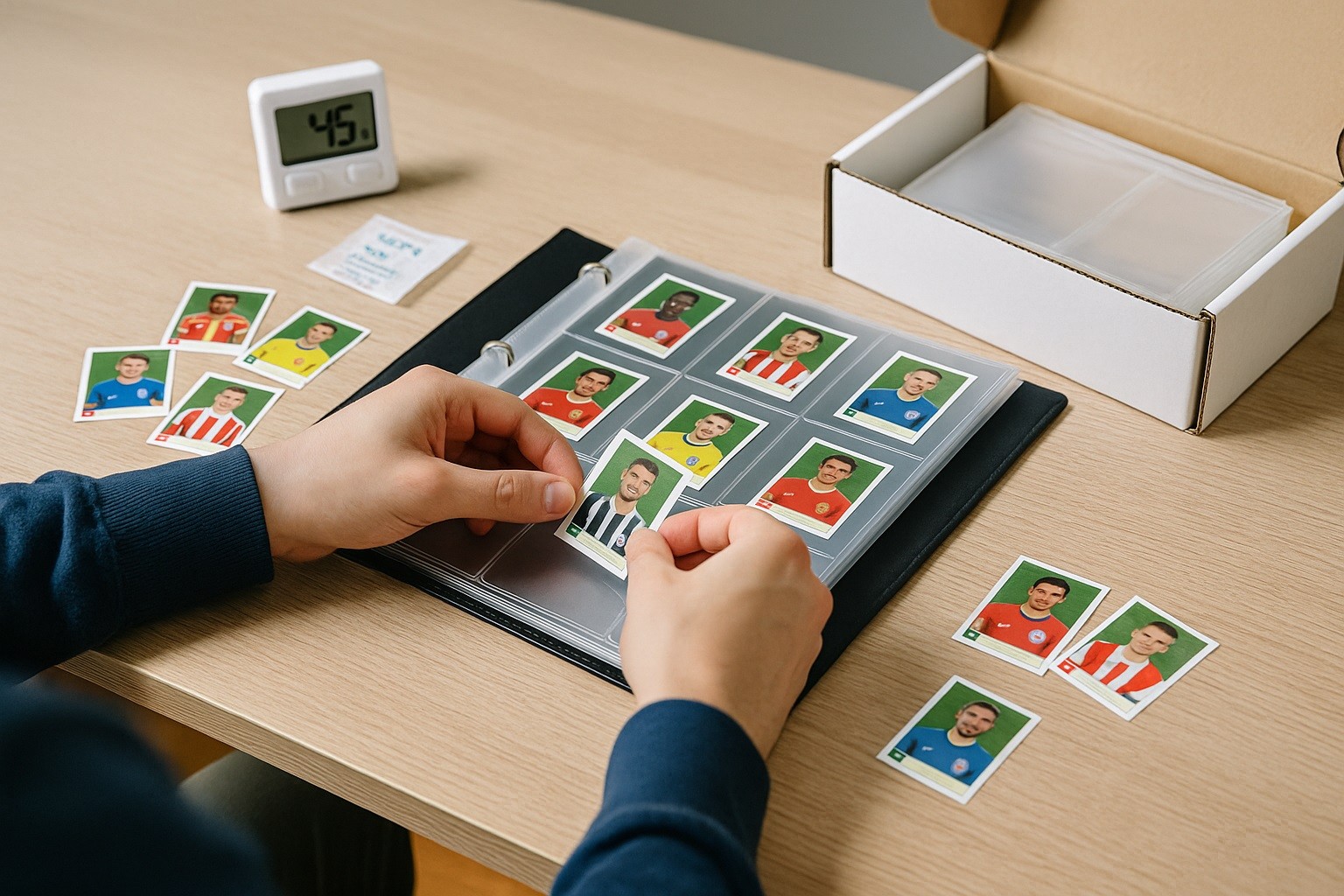
Pick a Storage Method That Fits Each Type of Sticker
Different stickers need different protection. Use a mix-and-match system that fits your collection size and goals.
1) Archival binder pages (organized sets)
Use PVC-free, acid-free pocket pages sized to your stickers. For Panini-style stickers, choose smaller pockets so pieces do not slide.
Store binders upright on a shelf to avoid bending and to keep pages from pressing into the rings. Do not overfill; leave room to reduce edge stress and page waves.
Keep binders in a dark cabinet or in a slipcase to block dust and light. Add a spine label so you can retrieve without dragging.
2) Sleeves + rigid holders (valuable singles)
For higher-value singles, use a two-layer approach. Start with a soft inner sleeve (PP/PE). Add a semi-rigid or toploader holder for structure.
This cuts friction and lowers bend risk. Avoid tight fits that pinch corners. If you bag the holder, use a resealable team bag instead of tape.
Tape can migrate adhesive or stick to surfaces if it shifts.
3) Archival storage boxes (bulk and backups)
Use acid-free card boxes or inert plastic cases to hold sleeved or toploaded stickers. Add silica gel and keep the box in a dark, stable climate cabinet.
Do not pack so tightly that holders bow. Do not leave them loose to rattle. Use box dividers to keep rows neat.
Label the exterior and keep a matching spreadsheet.
4) Albums already mounted? Protect the album, not just the pages
If you collect full albums, protect the entire object. Store each album in a snug, acid-free enclosure or slipcase to block dust and light.
Keep albums flat or upright with support so the spine does not deform. Maintain the same cool, dry, dark conditions noted above.
Use interleaving sheets only if the pages transfer ink or stick.
Handling Rules That Prevent Instant Wear
Wash and dry your hands before handling. Avoid lotions that leave residue.
Handle with two hands and support the piece so the corners do not catch.
Keep food and drinks away from the table. Do not write on holders or pages. Do not use rubber bands; they pressure-mark and degrade.
When inserting into sleeves, open the sleeve fully and slide slowly. Never force a tight sleeve over a thick or slightly irregular sticker.
Light: The Silent Value Killer
Light fades inks and chalks edges. Sunlight and strong LEDs do it faster. Keep stickers and albums in darkness except when viewing.
If you display anything, display a duplicate or a high-quality print, not your original.
If you insist on displaying an original, use UV-filter glazing, low light levels, and short rotations.
Track exposure time and return the item to storage.
Humidity: Prevent Waves, Mold, and Adhesive Issues
Humidity drives many failures. High humidity invites mold and softens adhesives. Very low humidity can embrittle paper and promote curling.
Aim for a stable band near one-third relative humidity. Avoid big swings across seasons. A dehumidifier for damp rooms helps.
In cabinets and boxes, use rechargeable silica gel and a small indicator card. Regenerate the gel when it saturates.
Temperature: Slow the Chemical Clock
Heat speeds up chemical decay. Keep the storage area cool and away from heat sources.
Do not place boxes near exterior walls that heat up in summer or radiators that cycle. Avoid closed cars and sunlit shelves.
If your room runs warm, lower the setpoint a few degrees or move the collection to an interior closet.
Air Quality: Silence The Unseen Attackers
Dust, fumes, and acids in the air attack paper. Keep storage closed and clean. Use lidded boxes and cabinet doors.
Do not store near fresh paint, new carpeting, or strong cleaners. Let new furniture off-gas before placing binders inside.
Avoid scented products that indicate volatile chemicals.
What to Avoid (common mistakes)
PVC pages and binders. Plasticizers and acids can migrate and stain over time. Choose PP, PE, or PET instead.
High heat, high humidity, and bright light. These accelerate fading, yellowing, and warping. Keep cool, dry, and dark.
Overstuffed binders. Pressure bends pieces and imprints edges. Store upright and leave space between binders.
Taping toploaders. Tape can contact the item or leave residue. Use a resealable bag or low-tack closure.
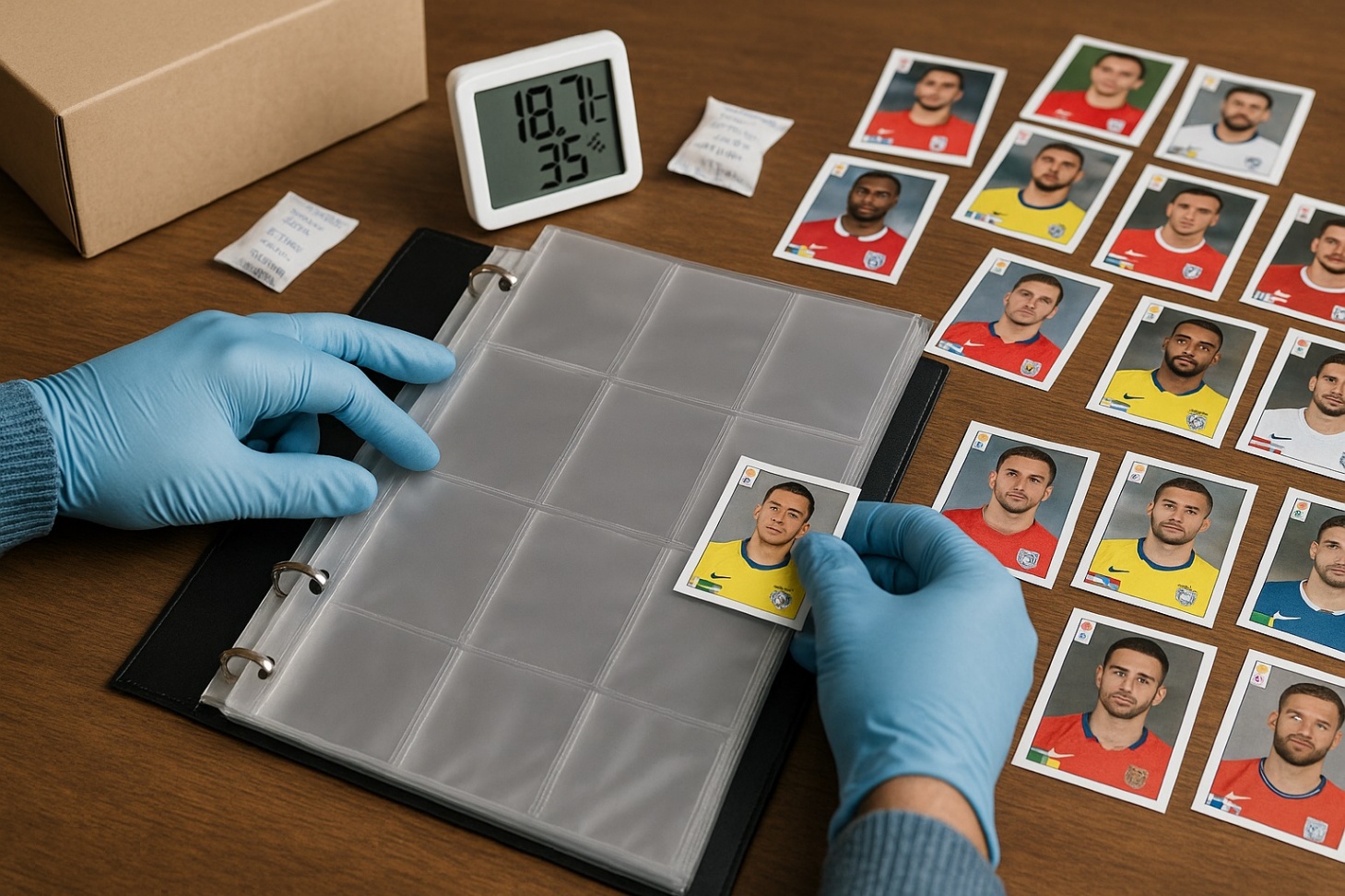
Step-by-Step Setup For a Small Collection
- Pick the space: Choose an interior closet or cabinet away from windows and heating or cooling sources. Put a small hygrometer inside. Target ≈18–20 °C and ≈30–40% RH. Keep the door closed and lights off.
- Choose housings: For sets, use PVC-free archival pages in a quality D-ring binder stored upright. For valuable singles, use a soft sleeve plus a semi-rigid or toploader, then a resealable bag. For bulk, use acid-free boxes with dividers and silica gel.
- Prepare the stickers: Wash hands. Clear the workspace. Sleeve carefully; avoid tight fits. Support pieces when moving between containers. Do not mix raw, unsleeved stickers with sleeved ones in the same pocket.
- Organize and label: Use box or binder dividers by set, year, or team. Label the container, not the item. Maintain a simple spreadsheet with locations. Review the list when you add or remove items.
- Maintain: Check the hygrometer monthly. Regenerate silica gel as needed. Dust shelves and wipe binder exteriors with a dry, lint-free cloth. Inspect a sample of stickers each quarter for early signs of waves, spots, or adhesive prints.
Bottom Line
Protect value by controlling the environment first. Use inert housings sized to your stickers. Handle gently and avoid pressure and light.
Keep it cool, dry, dark, and stable. Use PP, PE, or PET plastics and avoid PVC. Store binders upright and never overstuff.
For key pieces, sleeve, and add a rigid holder. If you follow these habits, you slow decay, keep colors true, and preserve both enjoyment and value.