For decades, football collecting meant paper lists, pocket money, and schoolyard swaps.
In the last 15 years, video games and apps reshaped that routine.
Digital packs, live updates, and global markets moved the hobby from kiosks to consoles and phones.
From Paper to Pixels: The Rise of “Packs”
A major shift came with the launch of Ultimate Team in 2009.
Players built squads by opening randomized packs of virtual cards, funded by in-game coins or real money.
The format mirrored card shops: tiers of rarity, chase items, and seasonal refreshes.
Pack openings became content. Streamers and YouTubers turned odds, price graphs, and “meta” squads into a daily conversation.
Live Football, Live Cards
Digital collecting synced with real fixtures. Items tied to weekly form, special events, and tournaments.
You didn’t just collect for the season; you collected for this weekend.
This cadence changed demand. Fans track promos like matchdays, not catalog numbers.
The live-service model kept collectors engaged year-round.

Panini Goes Digital—At Scale
Album culture also moved to screens. Panini’s official digital World Cup albums let fans open virtual packets, swap online, and chase completion badges.
The result was mass participation, with millions joining during recent tournaments.
The album experience became dual-track. Paper stayed central, but digital offered a parallel chase, sponsor tie-ins, and shareable milestones.
For new fans, the first “pack” might be a tap, not a tear.
New Competitors and New Formats
Other publishers expanded the field. Digital trading apps blend collecting, contests, and sometimes the option to print a physical version of a digital pull.
The wall between formats thinned.
Blockchain projects added ownership mechanics. Licensed fantasy platforms issued tradable digital cards used in weekly competitions.
The model drew fans—and regulators—showing how quickly collecting overlaps with gaming and consumer law.
Regulation Arrives at the Trade Table
Randomized packs raised a key question: are loot boxes gambling? Different countries took different paths.
Publishers responded with odds disclosures, spending controls, and market-specific changes.
For collectors, oversight is now part of the hobby. Access to features can vary by jurisdiction.
Odds and purchase tools are more visible than ever.
What Changed For Collectors
- Collecting became gameplay: Digital items do something: enter squads, score points, and unlock progression. Utility matters as much as aesthetics.
- Calendars, not catalogs: Demand follows fixtures, transfers, and tournaments. Events drive the chase.
- Global trading floors: In-game markets and apps created 24/7 price discovery. Young collectors learn supply and demand with badges and crests.
- Physical ↔ digital feedback loop: Digital albums onboard new fans who later buy packs; physical nostalgia fuels digital promos. Licensing battles now have digital stakes, fragmenting what used to be a single checklist.
- Guardrails: Terms like “loot box,” “odds disclosure,” and “responsible spending” entered everyday collecting language. Policy shapes design.
What Stayed The Same
Scarcity still drives desire. Whether coded in a drop rate or printed in a limited run, rarity moves hearts and wallets.
Community remains the engine. Swaps, Discords, and forums keep the playground spirit alive—just on a global scale.
Story still rules. A rookie, a milestone, a title—context gives a card meaning. Digital or paper, narrative sets the premium.
The Road Ahead: Interoperability and “Phygital” Proof
Expect more products that link a physical card to a verified digital record or in-game perk.
Collectors want official releases, clear scarcity, and proof of ownership. “Phygital” bundles meet those expectations.
Fans will push for items that work across experiences they already use. Rights holders will balance openness with brand control and integrity.
Policy will continue to shape features. Clearer consumer protections may slow some mechanics, but can build trust.
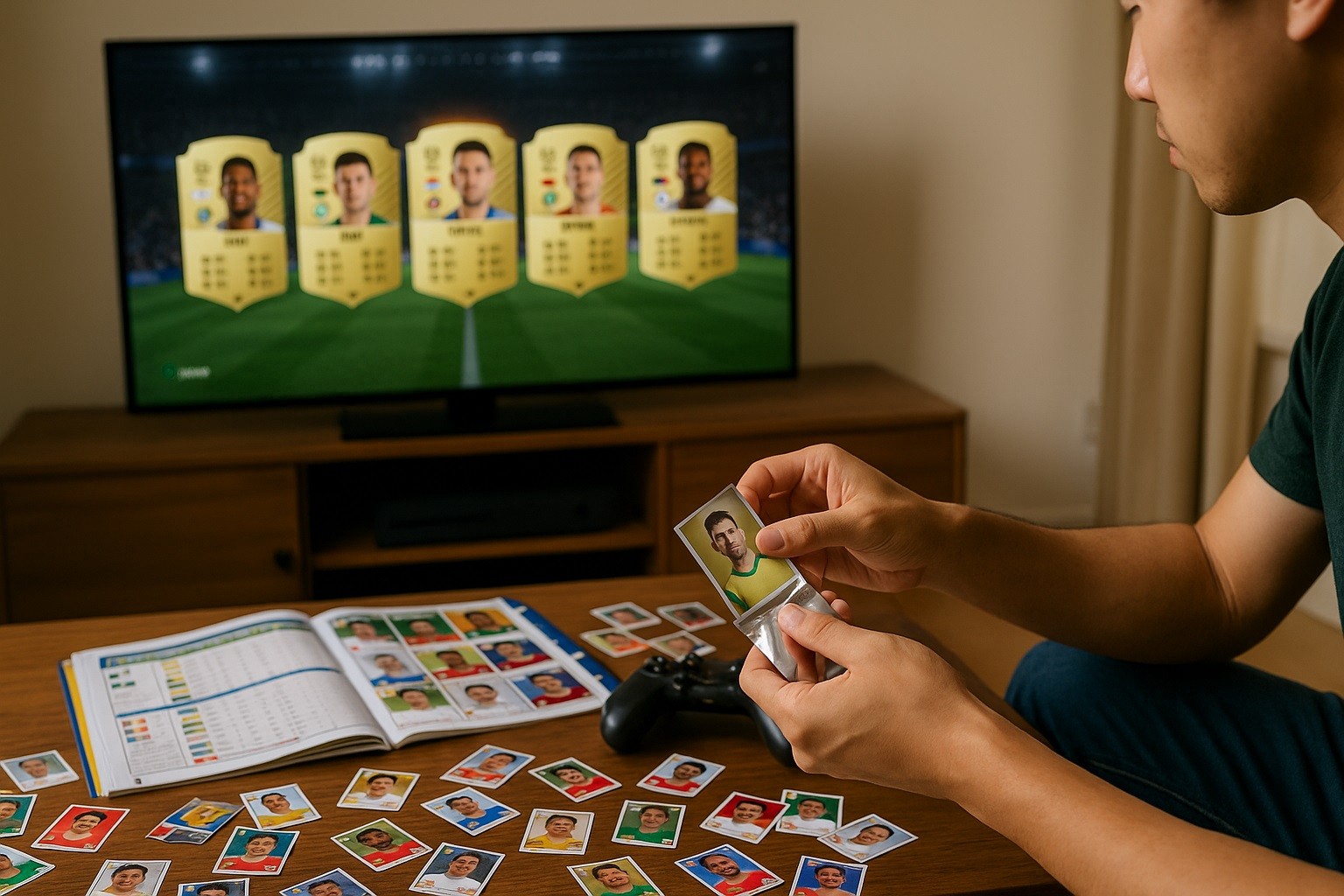
Timeline
Here’s a concise, source-backed timeline of key moments showing how video games and digital platforms reshaped football collecting.
- Feb 10, 2009 → Mar 19, 2009 — FIFA 09 Ultimate Team announced and released. EA unveils “Ultimate Team,” introducing randomized, tiered virtual card packs and a paid add-on, launching worldwide on Mar 19.
- 2014–2016 — Topps goes big on digital football apps. “Topps KICK” expands licenses and club coverage; Scottish leagues join in 2016, reflecting the early hybrid of fantasy + collecting.
- Mar–Jun 2018 — Panini’s World Cup digital albums scale globally. FIFA reports 3M+ digital collectors for Brazil 2014; Russia 2018 hits 2M users in three weeks and 6M by June.
- Jul 20, 2018 — Record digital engagement around Russia 2018. FIFA cites 7.5B+ engagements across its platforms, underlining the shift to app-based collecting rituals.
- FY2021 (reported May–Jun 2021) — Ultimate Team becomes an economic engine. EA discloses about $1.62B revenue from Ultimate Team modes that year, with the football title as the flagship.
- May 10, 2022 — EA and FIFA split; rebrand set. EA confirms the end of its 30-year FIFA naming deal; the franchise will continue as EA Sports FC from 2023.
- Jan 25, 2022 — Topps launches Total Football (digital + print-on-demand). New app lets fans rip digital packs and order physical prints of selected pulls, a clear “phygital” bridge.
- Jul 12, 2023 — Topps consolidates KICK content. KICK content migrates into Topps Digital Archives; cross-promos nudge users toward Total Football’s hybrid model.
- Apr–Jun 2024 — Euro 2024 licensing fracture confuses collectors. Topps holds UEFA rights for the official album, but key England stars are missing due to Panini’s retained rights; media highlight a split experience for fans.
- Sep 26, 2024 — UK regulator prosecutes Sorare. Britain’s Gambling Commission charges the NFT-based fantasy platform over alleged unlicensed gambling (Sorare denies); the case spotlights regulatory pressure on chance-based digital collecting. (Trial later set for June 16, 2025.)
- Oct 2023–2025 — EA Sports FC era; live services remain pivotal. Despite bumps around FC 25, coverage notes Ultimate Team–style live services still anchor bookings and engagement.
- May–Jun 2025 — Total Football leans further into “phygital.” Topps promotes redemptions and print-on-demand for premium inserts, tightening the loop between digital pulls and mailed physical cards.
- Jul–Aug 2025 — Premier League rights shift to Topps. Reports indicate Topps takes over Premier League trading cards and stickers from 2025/26, cementing an aggressive licensing push alongside UEFA deals.
- Ongoing — Panini/FIFA digital albums as a standing fixture. The digital album format, proven in 2014 and 2018, remains part of FIFA’s tournament-era fan engagement toolkit.
Bottom Line
Video games didn’t replace football stickers and cards. They reframed them into a live, interactive, global experience where collecting is action, not only acquisition.
Ultimate Team normalized packs and rarity on consoles. Digital albums scaled the ritual to millions.
The binder now sits beside a controller and a phone. For many fans, that mix feels natural: you collect to remember—and to play.